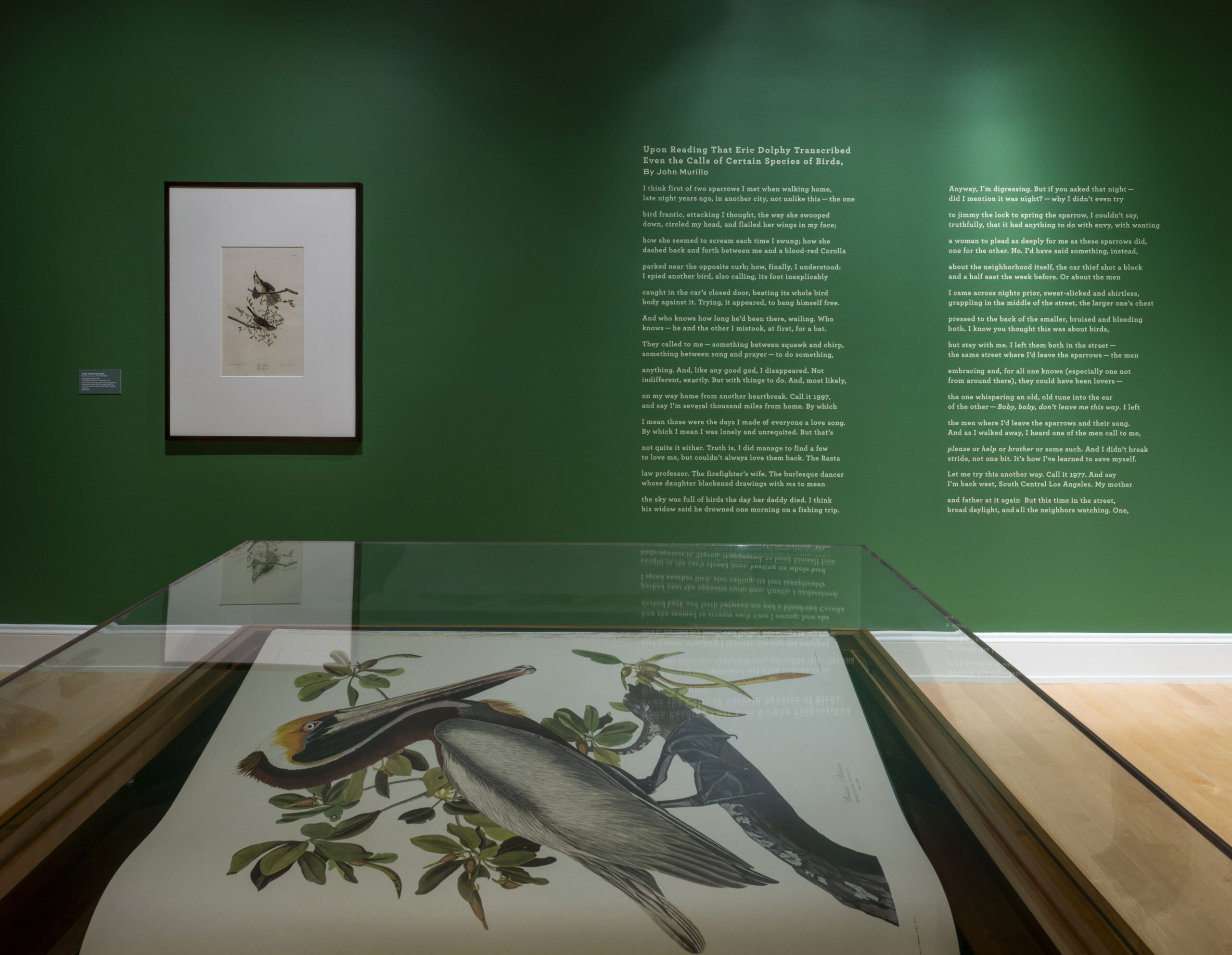
AUBURN, Ala. — The Jule Collins Smith Museum of Fine Art at Auburn University presents a new, cross-disciplinary project that brings together two seemingly different forms of art: Audubon’s prints in the university’s art collection and the written word. “Radical Naturalism: Lyric Birdscapes,” a yearlong exhibition, features selected etchings from “The Birds of America” curated by the museum’s poet-in-residence, Nicole Sealey, as well as poems, such as John Keats’ “Ode to a Nightingale,” inspired by the natural world, asking visitors to consider and explore how different art forms contend with the natural world and create or extend narratives around human relationships with nature. This presentation continues the museum’s “Radical Naturalism” series, which invites contemporary artists to research the university art collection and present new work in response to the 19th-century naturalist.
Over the academic year, Sealey, an award-winning author whose work explores race, identity and justice, is engaging with Auburn students and faculty in the Department of English. Through visits to The Jule, students in Poetry Writing: The Natural, the Social and the Personal created poetic responses to Audubon’s work. The student poems, along with audio recordings of their readings, are featured in the gallery adjacent to the prints featuring the birds found in their poems. Sealey also commissioned pieces from Donika Kelly and David Baker in response to the art on view. All of the audio recordings, including interviews with the commissioned poets, are featured as a series of The Jule Museum Podcast.
“This exhibition invites us to engage with Audubon’s ‘The Birds of America’ not only as an artistic and scientific achievement, but also as a historical artifact of his life and views,” said Chris Molinski, the Janet L. Nolan Director of Curatorial and Educational Affairs. “By pairing these images with poetry, we’re creating space for reflection. It’s a powerful way for students to explore how art and literature can both preserve and challenge these narratives.”
The Jule continues to serve as a campus resource for experiential learning, offering students opportunities to engage with artists, curators and scholars in meaningful ways. This exhibition exemplifies the museum’s commitment to fostering creativity, critical thinking and collaboration.
A longtime partner is Rose McClarney, the co-editor-in-chief of the “Southern Humanities Review” and the Lanier Endowed Professor. Since 2014, the museum has hosted the Auburn Witness Poetry Prize Event in conjunction with the quarterly literary publication’s prize honoring an alumnus, the late Jake Adam York. The juried poetry competition has created avenues for other forms of teaching with objects, including this latest iteration of “Radical Naturalism.”
McClarney said that while her courses have always focused on published texts as a means of teaching creative writing and poetry, she balances days of close reading with time for students to develop their observation skills with the visual arts.
“Students’ responses to visits to the museum have convinced me of the value of adding activities that take place outside of the classroom and our discipline,“ said McClarney. “Museum visits result in student poems of surprising originality that reach beyond expected reflections on the self into more expansive thinking. [They] remark on our time together at the museum as some of their most memorable, convivial and enjoyable educational experiences.”
Jule poet-in-residence Nicole Sealey says the exhibition is an attempt at a marriage between art forms. “I think for poetry, we try to find a way to say a thing that is unsayable, and I think the same goes for visual arts,” said Sealey. “I think poetry and visual arts come pretty close. That’s a way for us to stay in conversation with the people before us and the people after us, and it’s a way to stay connected to the present.” Sealey also hopes the exhibition invites visitors to engage in further humanistic inquiry by reading more poetry beyond the walls of the museum.
“Many people are familiar with Audubon’s images, even if they don’t usually visit art museums and may not feel confident that they belong there,” McClarney said. “If they are comfortable reacting to these familiar works, then that can lead them to believe that they are able to think meaningfully about the poetry Sealey has selected and other items in the museum.”
“The majority of the poems in the exhibit end in questions, and I hope readers will sense an openness in them, an invitation to contribute their impressions.”
“Radical Naturalism: Lyric Birdscapes” is on view through Thursday, July 2, 2026. Museum admission is free, with drop-in tours led by student guides and staff each Tuesday through Saturday at 5 p.m. Faculty are encouraged to direct students for self-study or may arrange for a class tour or study room session by visiting jcsm.auburn.edu.