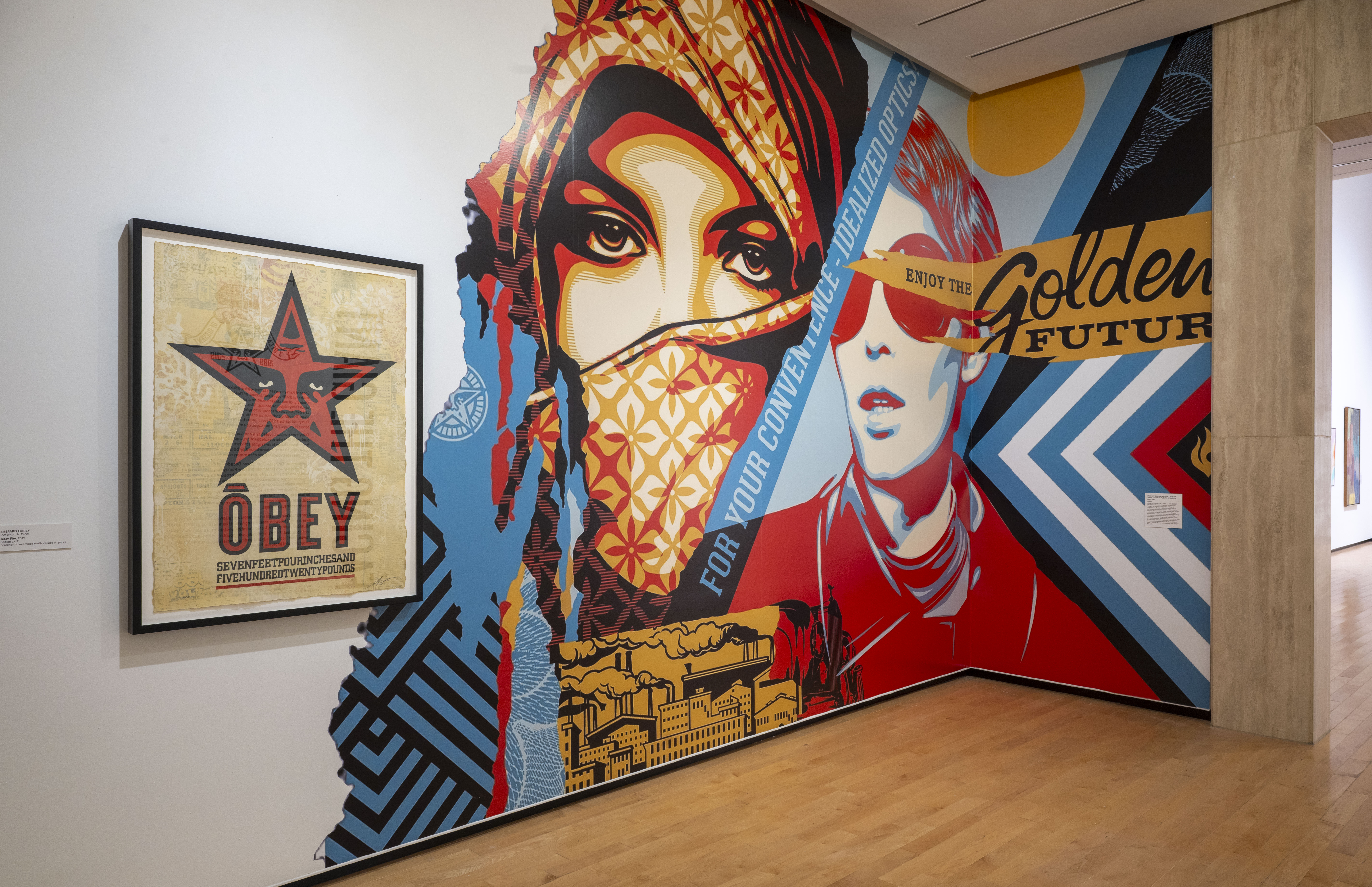
AUBURN, Ala. — A pair of kohl-brushed eyes peer across the Noel and Kathryn Dickinson Wadsworth Gallery at The Jule Collins Smith Museum of Fine Art, gazing at their inspiration mounted on the adjacent walls: posters, one after another, composed of bright colors, strong lines and bold messages. These eyes beckon visitors to look closely as they enter the galleries filled with Facing the Giant—3 Decades of Dissent: Shepard Fairey, the latest exhibition on view at Auburn’s art museum through Sunday, May 9.
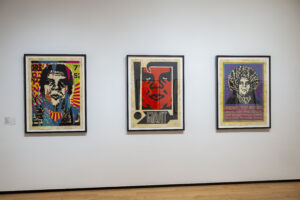
Prints from Shepard Fairey’s iconic “Andre the Giant Has a Posse” series. Photo: Mike Cortez.
Born in Charleston, South Carolina, Shepard Fairey is an internationally known “street artist” and print maker, famous for his embrace of punk rock, skateboarding and DIY culture. His art is recognizable in and outside of art museums and galleries—Fairey notably created the Andre the Giant Has a Posse street art campaign, as well as the Obama “Hope” unofficial 2008 campaign poster. Beyond print making, Fairey also found notoriety for his forays into fashion, developing, shaping and launching the OBEY clothing line in 2001.
Fairey’s work has inspired generations of graphic designers, fashion designers and contemporary artists, making The Jule’s latest exhibition fertile inspiration for Auburn University students and faculty. For Riva Nayaju’s graphic design students in Image I, that meant an opportunity to apply their blossoming skills to the real world.
Real-World Student Experience
Image I is an image-based design course that applies illustration techniques and concepts to a variety of graphic formats, bridging the gap between hand-drawn creations and digital creative software, helping budding designers see how they can bring their ideas into the real world. While most projects graphic design students tackle in the classroom are theoretical in nature, a collaboration with The Jule presented the opportunity to create something with real stakes: it could end up on the gallery walls.
“This project is really emblematic of The Jule’s value to both faculty and students,” said Chris Molinski, the Janet L. Nolan Director of Curatorial and Educational Affairs. “Not only were students able to gain portfolio experience, they were able to learn so much more than just graphic design by utilizing the campus art museum.” Molinski noted that The Jule is open to faculty across all disciplines to work with museum educators to imagine new active learning opportunities in a nationally recognized art museum.
“It was definitely new and different because it’s more of a real-world project, which we’ve never really had to deal with before,” said Morgan Meritt, one of the graphic design students in the course. “Most of all the projects we’ve done, we’re given a problem and told to fix it, but this was like an actual job we were given.”
“We worked with [Professor Nayaju] to think about how we could facilitate an exhibition design project,” said Christy Barlow, assistant director of education, engagement and learning at The Jule. “We’re a museum. We’re the perfect place to do this.” After the students were introduced to the project in class, they visited The Jule for a specialized tour that focused on color choices of the gallery walls, fonts of exhibition text and object labels and other aspects of exhibition design undertaken by museum staff. “We gave the students time to actually go into the galleries, measure, talk about spaces, brainstorm ideas and think about how they could potentially design something that would highlight this exhibition,” said Barlow.
“We were going to take the content from the artist and then create a corresponding design,” said Alex Dudley, a senior graphic design major who was enrolled in the course. “This was a much bigger project than what we’d normally work on.” Dudley, a student guide with The Jule’s Curatorial and Educational Affairs unit, also said their goal as a class was to learn to think about design elements in a cohesive way.
Morgan Merrett, Kate Eden and Charlotte Blencowe, who proposed what would become the final treatment, approached the idea of cohesion from more than just color-matching and aesthetics. To create a unique visitor experience, they focused on crafting an immersive narrative to allow visitors to experience Fairey’s art rather than just look at it. “I was like, ‘we need to tell a story,’” said Blencowe. “That was sort of the guiding principle throughout the entire project and our full design.”
“I think everyone knows who Shepard Fairey is, especially in the graphic design world,” said Merrett. “We wanted to dig deeper because we were very surface level to begin with. We were doing things that were expected, but we wanted to learn more about him [as an artist] so it could be a little more unexpected.” The team’s deep-dive into Fairey’s work and lean toward immersive storytelling paid off — after sitting in on the Image I final presentations, Molinski sent the top three student projects to Fairey’s studio. The artist himself hand-picked Merrett and Blencowe’s co-created designs for installation.
“Instead of working on an exhibition design project as something that’s just in the abstract, these students were actually able to work with a client and think about how to meet a client’s needs and gain that real-world experience,” said Barlow. “The students’ whose design was chosen – that’s something they have in their portfolios, something they can take to future employers. We’re able to be that conduit between the classroom and the working world.”
A Unique Teaching Tool
In addition to giving Auburn students real-world experiences, collaborations with The Jule also offer a unique approach to teaching for faculty across disciplines. “I was really interested to see where this [collaboration] would lead,” said Nayaju of working with Auburn’s art museum. “I was really excited.”
Nayaju, assistant professor in the School of Industrial and Graphic Design at Auburn’s College of Architecture, Construction and Design, noted the pedagogical value of moving away from theoretical assignments to client-based projects. “A lot of times, in a class setting, we usually have hypothetical clients, so we have to come up with projects, and [the students] have to come up with who their audience is,” said Nayaju. “But with this one, it was already set—this is a real-life project.”
Auburn’s focus on student experience points back to a well-known truth of higher education, that students learn more than just what’s assigned to them in their coursework. “I wanted them to be able to refine their communication skills,” said Nayaju. “After graduating, they’re going to have to do a lot of communication in terms of selling their project, so this was a very good opportunity for that.”
“We don’t get a lot of group projects,” Blencowe noted. “We were like, ‘That’s new. How do we even do that?’” Not only were students having to utilize their budding design skills to create something for Fairey’s exhibition, they also were learning softer skills of in-person work, including working in teams, negotiating ideas and active listening. “Everybody’s goal was to create this cohesive exhibition design,” said Nayaju. “They had so many different ideas… and it was hard for them to narrow down, like, ‘Okay, how are we going to bring all the ideas together and make this meaningful?’”
Students also had to learn how to apply their skills in new ways. “I had to learn to problem-solve in a 3-D area, which was completely new to me,” said Blencowe. “People are physically walking through this, and I had to figure out how to share the story that we were trying to inform people of in a 3-D space.” Because Auburn’s art museum exists in the real world, designers also can’t choose to manipulate room size, doorway placement, or wall angles. “We really had to work with the existing structure that’s already here,” said Blencowe. “Where the doorways are, where the part of the wall open[s] to move stuff in—all those things were huge factors.” Blencowe also noted how getting to come into the physical space of the museum to see for themselves what they were expected to work with helped shape the storyline the students wanted visitors to walk through and experience. “That wouldn’t have been possible without coming [to the museum] first.”
“This particular group [that was chosen for installation] was very particular about what art they wanted where,” said Nayaju, noting the students’ connections between graphic and exhibition design as a result of their unique tour from museum staff. “The reasons for what they came up with were very impressive.”
A Mural Is Born
To take the students’ ideas from concept to on the walls, museum staff worked to bring them to life. “The curatorial and design staff here worked with the students to think about how to translate
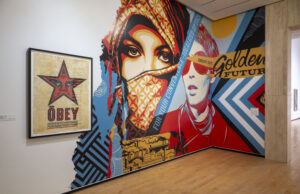
Mural design installed by Jule staff and created by Auburn University design students. Photo: Mike Cortez.
[their ideas] into the exhibition design,” said Barlow. “We had to think about what the most impactful elements of their design were, and those were the ones that we translated.” During the winter break, members of the curatorial and design units worked together and with external vendors to create, print and install the design elements from Merrett, Eden and Blencowe. Visitors can see the mural in-person when they walk through either doorway of the Noel and Kathryn Dickinson Wadsworth Gallery.
“None of us actually believed it was going to be put in there,” laughed Merrett. “I do brag about it often because I’m like, ‘Hey, I’m in a museum.’”
“It’s so iconic,” said Blencowe, gazing at the mural. “We worked so hard on [that] specifically because we wanted something big and overpowering. We wanted people to walk into this room and be immediately grabbed, and it definitely does that.”
Fairey’s exhibition and the accompanying student design elements are both on view at The Jule through May 9, 2026. Admission and registration are free. Visit jcsm.auburn.edu for more information.